
Synopsis
The year 2027 has officially retired the era of 2D blueprints and static artistic renderings as the primary tools for golf development. This blog explores the transformative power of Virtual Reality (VR) and “Digital Twins” in the modern architectural workflow. We examine how Golf Course Architecture Firms are now creating fully immersive, playable 1:1 digital replicas of their designs before a single cubic meter of earth is moved. We detail the specialized Golf Course Architecture Services that allow stakeholders—from club boards to environmental regulators—to walk the fairways, test sightlines, and simulate sunlight patterns across greens in a virtual environment. By leveraging these high-fidelity visualizations, Golf Course Design Architects are eliminating construction guesswork, accelerating the approval process, and ensuring that the final “Signature Golf Course Build” is an exact match for the developer’s vision. We analyze how this “Digital-First” approach is saving millions in potential on-site adjustments and setting a new global benchmark for transparency and precision.
Table Of Content
- Beyond the Blueprint: The 2027 Visualization Standard
- Virtual Reality: "Walking" the Course Before Construction
- The Power of the "Digital Twin": Real-Time Simulation
- Accelerating Approvals: Transparency for Regulators and Members
- Specialized Golf Course Architecture Services for High-Tech Visuals
- Eliminating the "Field Adjustment": Saving Time and Capital
- NWD Golf: Our Virtual Vision for Your Project
- Engineering Certainty in a Digital World
Beyond the Blueprint: The 2027 Visualization Standard
In the high-stakes world of 2027 golf development, “seeing is believing” has been replaced by “experiencing is knowing.” Traditional 2D drawings and even 3D static models are no longer sufficient to secure the massive capital required for a modern resort or residential project. Golf Course Architecture Firms have pivoted toward “Immersive Visualization.” This involves the creation of a “Digital Twin”—a hyper-realistic, data-rich virtual model of the course. This digital asset is not just a picture; it is a living simulation that accounts for topography, soil types, and even the growth rates of specific tree species, providing the most accurate preview of a project’s future success ever conceived in Master Planning.
Why Digital Twins are Essential for Modern Master Planning
A Digital Twin serves as the “Single Source of Truth” for an entire development team. Golf Course Architecture Firms use these models to coordinate with civil engineers, hydrologists, and real estate marketers. By providing specialized Golf Course Architecture Services that include a Digital Twin, firms ensure that every stakeholder is looking at the same 1:1 scale reality. This level of technical Master Planning identifies potential conflicts—such as a drainage pipe intersecting with a planned bunker or a villa blocking a signature view—long before they become expensive problems on the construction site.
Virtual Reality: "Walking" the Course Before Construction
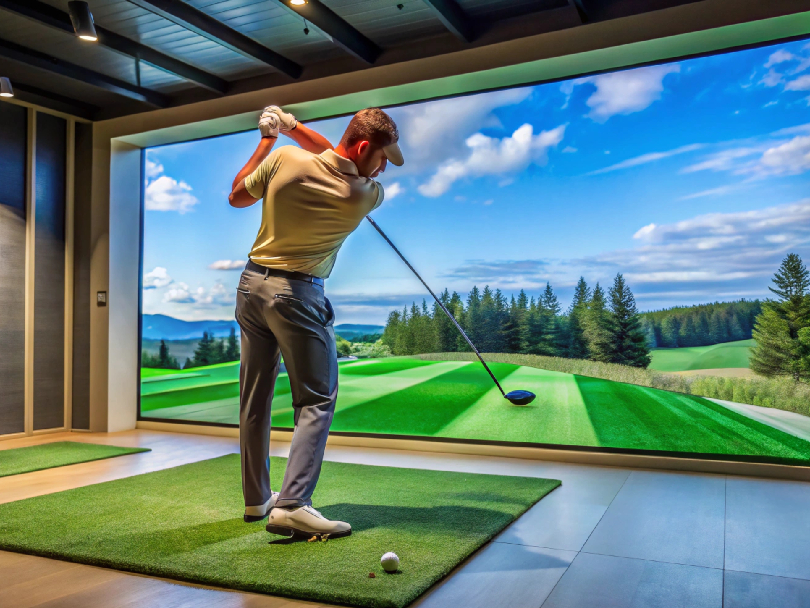
Virtual Reality (VR) has moved from a novelty to a non-negotiable part of the design process. In 2027, Golf Course Design Architects invite clients to don a VR headset and “walk” the routing of the course. You can stand on the 4th tee, look toward the green, and see exactly how the morning sun will cast shadows across the bunkers. This “First-Person Perspective” allows for a deep emotional connection with the design. It allows the owner to experience the “Scale and Drama” of the site, ensuring that the strategic intent is perfectly understood and approved before the first bulldozer arrives.
Testing Strategy and Sightlines in a 1:1 Environment
One of the greatest benefits of VR is the ability to “Play-Test” the course virtually. Golf Course Design Architects can simulate shots from various skill levels to ensure the course is “Fair but Firm.” We can check if a fairway bunker is visible to a shorter hitter or if a “Heroic” carry is too intimidating for the average resort guest. This level of precision, integrated into modern Golf Course Architecture Services, allows for the refinement of the “Strategic Puzzle” in the digital realm, where adjustments are free, rather than in the physical realm, where they are costly.
The Power of the "Digital Twin": Real-Time Simulation
Unlike a static rendering, a Digital Twin is a “Simulation Engine.” In 2027, Golf Course Architecture Firms use these models to simulate environmental impacts. We can “turn on the rain” and see exactly how water will flow off the fairways and into the reservoirs. We can adjust the time of year to see how winter shadows might affect the health of the turf on the 12th green. This “Predictive Modeling” is a cornerstone of our Master Planning for 2027, ensuring that the course is not only beautiful but also operationally resilient and agronomically sound from day one.
Accelerating Approvals: Transparency for Regulators and Members
Securing permits and member buy-in is often the slowest part of a Golf Course Renovation or new build. Digital Twins and VR provide a level of transparency that traditional methods cannot match. When regulators can “fly through” the proposed wetlands or members can “see” how the new 18th hole will look from the clubhouse terrace, resistance often fades. Golf Course Architecture Services now include the creation of “Interactive Experiences” that allow communities to understand the environmental and aesthetic benefits of a project, significantly accelerating the approval timeline.
Specialized Golf Course Architecture Services for High-Tech Visuals
Creating a 2027-standard Digital Twin requires a suite of specialized Golf Course Architecture Services. This starts with high-resolution LiDAR drone surveys to capture the existing terrain with sub-centimeter accuracy. Our team then layers in the architectural design, 3D foliage models, and atmospheric lighting. This is a highly technical process that merges the skills of a Golf Course Design Architects with those of a high-end game developer. The result is a “Marketing and Engineering Powerhouse” that serves the project through design, construction, and eventual operation.
Eliminating the "Field Adjustment": Saving Time and Capital
The most significant ROI of high-fidelity visualization is the elimination of the “Change Order.” Historically, many design tweaks happened in the field once the architect saw the “real” scale of a feature. In 2027, those “Field Adjustments” happen in the VR suite. By resolving these details digitally, Golf Course Architecture Firms save developers hundreds of thousands in machine time, fuel, and labor. This “Digital Certainty” ensures that the Signature Golf Course Build is delivered on time and on budget, as the construction crew is simply following a “Pre-Verified” 3D road map.
NWD Golf: Our Virtual Vision for Your Project
NWD Golf is a leader in the digital revolution. We provide the Master Planning and Golf Course Architecture Services necessary to bring your project to life in the virtual world before we build it in the physical one. Our team of Golf Course Design Architects uses the most advanced VR and Digital Twin technology available in 2027 to ensure that your vision is perfectly realized. We believe that the future of golf design is digital, and we are here to provide the “Digital Foundation” for your success.
Engineering Certainty in a Digital World
Is your project still being designed in 2D? Partner with NWD Golf to experience the “Digital Twin” advantage. Let us help you “Walk the Future” of your course today, ensuring that every hole is a masterpiece of strategy, aesthetics, and engineering precision.
What is a "Digital Twin" in golf course architecture?
A “Digital Twin” is a hyper-realistic, 1:1 scale virtual replica of a physical golf course design. In 2027, it is used by Golf Course Architecture Firms as a living simulation tool. It incorporates real-world topographic data and allows architects to simulate environmental factors like drainage, sunlight, and turf growth. This ensures that the Master Planning is technically flawless and provides a “Single Source of Truth” for the entire development team.
How does Virtual Reality (VR) help a developer during the design phase?
VR allows a developer to “Immerse” themselves in the course before it is built. By walking the routing and testing sightlines in a virtual environment, they can experience the “Drama and Scale” of the design. This helps Golf Course Design Architects communicate their vision more effectively, allowing for immediate feedback and adjustments in the digital realm, which is much faster and cheaper than making changes during the physical construction phase.
Can VR be used to test the "Strategy" of a golf course?
Yes. One of the primary uses of VR in 2027 is “Strategic Play-Testing.” Architects can simulate shots from various distances to ensure that hazards are correctly positioned and that the course offers a fair challenge for all skill levels. By providing these specialized Golf Course Architecture Services, firms ensure that the “Strategic Puzzle” is perfectly balanced, reducing the need for expensive “Field Adjustments” once the course is actually built.
How do Digital Twins accelerate the environmental approval process?
Digital Twins provide regulators with a transparent, data-backed view of the project’s environmental impact. They can “See” exactly how wetlands will be preserved, how drainage will be managed, and how the course will sit within the natural landscape. This level of “Visual Certainty” reduces skepticism and helps Golf Course Architecture Firms secure permits faster, as the “Digital Twin” acts as a definitive proof of the project’s sustainability and commitment to the local ecology.
How do Digital Twins accelerate the environmental approval process?
Digital Twins provide regulators with a transparent, data-backed view of the project’s environmental impact. They can “See” exactly how wetlands will be preserved, how drainage will be managed, and how the course will sit within the natural landscape. This level of “Visual Certainty” reduces skepticism and helps Golf Course Architecture Firms secure permits faster, as the “Digital Twin” acts as a definitive proof of the project’s sustainability and commitment to the local ecology.
Is the investment in high-tech visualization worth the cost?
Absolutely. While creating a Digital Twin and VR suite involves an upfront cost, the ROI is realized through the elimination of “Change Orders” during construction. By resolving all design and engineering conflicts digitally, clubs can save up to 10% of their total construction budget. Furthermore, these assets are invaluable for pre-sales of real estate and memberships, making them a primary driver of the project’s commercial success in the 2027 market.

Pierfrancesco De Simone is a European Institute-accredited golf architect and engineer known for seamlessly merging ecology with modern strategy. With projects across Europe and Africa, he specialises in water-wise routing and habitat-rich design. At NWD Golf, Pierfrancesco advances sustainable innovation, ensuring every feature—from bunkers to waterways—respects land heritage while inspiring contemporary play.
- Pierfrancesco De Simonehttps://nwdgolf.com/blogs/author/pierfrancesco-de-simone/
- Pierfrancesco De Simonehttps://nwdgolf.com/blogs/author/pierfrancesco-de-simone/
- Pierfrancesco De Simonehttps://nwdgolf.com/blogs/author/pierfrancesco-de-simone/
- Pierfrancesco De Simonehttps://nwdgolf.com/blogs/author/pierfrancesco-de-simone/