
Synopsis
Legacy golf courses carry rich historical narratives, but aging subsoil infrastructure and changing equipment technology often render them uncompetitive or maintenance-heavy. This blog explores how NWD Golf executes historic course modernizations without destroying classic design architecture. We detail how upgrading greens to USGA specifications, refining fairway contours, and applying advanced bunker lining technologies restore original strategic intent while reducing maintenance labor. By analyzing real-world renovation frameworks across historic venues, we demonstrate how targeted architectural updates improve agronomic health, enhance player accessibility, and protect the long-term capital value of heritage clubs. Discover how NWD Golf combines historic restoration with modern civil engineering to deliver a championship-grade playing surface that stands up to modern equipment while preserving the soul of the original design. Partnering with NWD Golf ensures your heritage facility transforms from a high-maintenance asset into an enduring, eco-certified landmark that maintains operational efficiency, fast playing surfaces, and high member satisfaction across generations.
Table Of Content
- The Preservation Dilemma: Protecting Heritage While Adapting to Modern Play
- Strategic Restoration: Restoring Historical Design Intent Across Play Corridors
- Subsurface Evolution: Engineering USGA Specification Greens Profile
- Hazard Modernization: Applying Advanced Bunker Liners and Synthetic Edges
- Fairway Contouring and Selective Clearance for Sun Exposure and Airflow
- Agronomic Transformation: Upgrading Turf Cultivars for Climate Resilience
- NWD Golf: World Leaders in Historic Renovation and Architectural Mastery
- Our Specialized Historic Master Planning and Renovation Services
The Preservation Dilemma: Protecting Heritage While Adapting to Modern Play
Historic golf courses represent irreplaceable monuments of sports architecture, capturing the artistic philosophy and strategic genius of early master builders. However, managing legacy properties in the modern era presents significant civil, agronomic, and operational challenges. Over decades of play, original green complexes shrink due to perimeter mowing drift, bunkers suffer severe edge erosion, and subsoil clay pipes collapse, leading to chronic waterlogging. Furthermore, advancements in modern golf equipment—such as forgiving driver heads and solid-core golf balls—allow players to generate unprecedented distance, rendering historic hazard placements obsolete. Master developers and heritage club boards face the delicate challenge of modernizing infrastructure to withstand modern play without erasing the classic character that defines the club’s identity. At NWD Golf, we resolve this tension by deploying surgical renovation frameworks that preserve architectural heritage while embedding state-of-the-art infrastructure beneath the turf.
Strategic Restoration: Restoring Historical Design Intent Across Play Corridors
Executing a successful historic restoration requires extensive archival research, historical photo analysis, and high-resolution LiDAR land mapping prior to moving a single cubic meter of soil. Over decades, organic thatch buildup and uncoordinated minor repairs gradually fill in natural micro-contours, blunting the artistic nuances of original green complexes and fairway approach slopes. NWD Golf utilizes specialized digital terrain mapping to uncover the original parameter boundaries of classic greens, expanding putting surfaces back to their historic footprints. This spatial restoration recovers lost pin positions, restores original approach collection hollows, and re-establishes the strategic angles of attack intended by the original architect. By aligning historical spatial intent with modern player dispersion data, we ensure the layout provides a authentic strategic test for both elite professional players and high-handicap club members.
Subsurface Evolution: Engineering USGA Specification Greens Profile
The physical core of legacy course modernization centers on rebuilding aging push-up green complexes to meet strict USGA specifications. Original push-up greens, built primarily from local topsoil, suffer from extreme compaction, poor aeration, and slow water infiltration rates, leading to severe root rot and turf failure during humid summer months. Our engineering teams replace these failing soil profiles by excavating the green complex and installing a multi-tiered USGA subsoil matrix. This profile features a continuous four-inch washed gravel drainage blanket, a network of perforated subsoil collection pipes, and a precisely blended 12-inch sand-organic rootzone layer. This high-capacity hydraulic infrastructure guarantees rapid water movement during storm events while maintaining ideal capillary moisture balance and deep rootzone oxygenation. Rebuilding greens to USGA standards restores firm, fast putting surfaces that resist heavy foot traffic and extreme climate shifts year-round.
Hazard Modernization: Applying Advanced Bunker Liners and Synthetic Edges
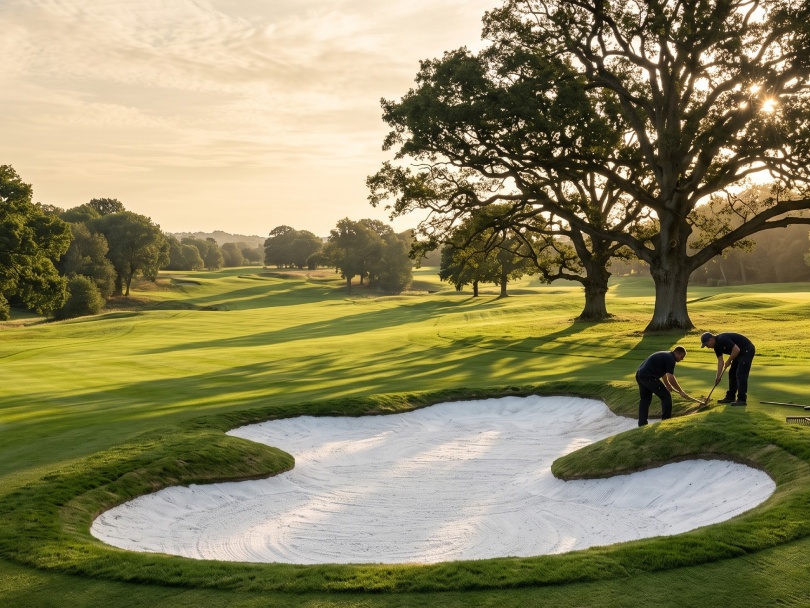
Bunkers on historic courses are frequently the largest source of annual operational maintenance expenditure due to sand washout, soil contamination, and failing turf edges. Traditional soil-backed bunkers allow heavy rains to wash mud down into the sand, requiring continuous hand-raking, sand replacement, and labor-intensive edge trimming. NWD Golf modernizes legacy bunker complexes by introducing advanced synthetic liner systems and EcoBunker stacked turf edges. We line the excavated bunker base with high-permeability SoftBunker aggregate layers that lock the clean sand in place while allowing rainwater to drain instantly into subsurface pipes. By constructing the bunker faces with stacked synthetic turf layers, we eliminate edge breakdown and prevent soil contamination completely. This structural stabilization cuts bunker maintenance labor by up to 50% while preserving the classic, dramatic hazard shaping that defines historic architecture.
Fairway Contouring and Selective Clearance for Sun Exposure and Airflow
Over decades of growth, unmanaged tree canopies and overgrown undergrowth gradually encroach upon classic fairway corridors, choking out sunlight and restricting essential surface airflow around greens and tees. Shade and stagnant air weaken turfgrass plants, making them highly susceptible to fungal diseases, soil capping, and winter die-offs. NWD Golf performs precise shade-mapping and micro-climate airflow analyses across historic properties to execute targeted vegetation management plans. We selectively remove non-native undergrowth and prune overextended tree limbs, opening up the playing corridors to essential morning sunlight and prevailing breezes. This environmental clearance improves natural turfgrass vigor, reduces reliance on chemical fungicides, and reveals breathtaking historic sightlines across the property that had been obscured for generations.
Agronomic Transformation: Upgrading Turf Cultivars for Climate Resilience
Modernizing a historic course requires replacing legacy, high-input turfgrasses with advanced warm-season or cool-season cultivars engineered for climate resilience and low water consumption. Legacy properties frequently feature mixed, weak grass varieties that require heavy chemical inputs, high-volume freshwater irrigation, and intensive daily mowing to maintain playability. Our agronomic teams execute full-scale turf conversions, establishing certified, drought-tolerant turfgrasses such as advanced bermudagrasses or Seashore Paspalum across fairways and tees. These modern cultivars possess deep root systems, high salt tolerance, and exceptional recovery rates from heavy wear. Converting the course to modern turf varieties allows the facility to operate on non-potable recycled water sources (TSE), drastically reducing utility bills while delivering lush, uniform, and tournament-ready playing conditions across all seasons.
NWD Golf: World Leaders in Historic Renovation and Architectural Mastery
Preserving the soul of a historic golf course while transforming its civil performance demands an architectural firm with proven global experience, historical reverence, and deep engineering capabilities. NWD Golf stands as the preeminent global authority on legacy course modernization, leveraging 52 years of collective design heritage across world-renowned championship venues. The NWD Golf brand is synonymous with historical course restoration, ensuring your heritage property functions as a low-maintenance, structurally sound landmark that leads the international golf community. Our lead architects personally direct every phase of the archival research, spatial routing, and subsoil construction, guaranteeing a seamless blend of timeless sports artistry and high-performance civil engineering.
Our Specialized Historic Master Planning and Renovation Services
Our specialized historic renovation services include complete archival research audits, LiDAR spatial mapping, USGA green complex re-engineering, and full-scale bunker modernization layouts. We work in direct coordination with historic preservation boards, club committees, and environmental agencies to ensure your renovation honors local heritage while meeting international sports standards. NWD Golf provides total project management, from checking subsoil chemical properties to calibrating advanced subsurface drainage networks. As pioneers of historical course restoration, we offer the data-driven design insights needed to turn aging heritage liabilities into your club’s greatest driver of operational stability, member satisfaction, and long-term asset value. Partner with NWD Golf to secure the future of your historic property for generations to come.
How does NWD Golf preserve the original design intent during a historic course renovation?
Preserving historical design intent requires combining deep archival research with modern spatial mapping technology before any physical earthmoving occurs. NWD Golf analyzes historic course photography, original hand-drawn architectural sketches, and historical routing maps alongside high-resolution LiDAR terrain scans. This process allows our architects to identify exact historical green perimeters, original bunker placements, and fairway collection hollows that have drifted or filled in over time. By restoring these original spatial parameters while embedding modern subsurface drainage beneath the surface, we ensure the course retains its authentic historic character while meeting the demands of modern championship play.
Why is upgrading greens to USGA specifications essential during a legacy course modernization?
Upgrading aging greens to strict USGA specifications is essential because legacy push-up greens built from local topsoil lack the drainage capacity and structural stability needed for modern foot traffic and severe weather. Push-up greens compact easily, leading to stagnant rootzones, hypoxia, and severe turf loss during hot, rainy seasons. A USGA-spec green utilizes a layered subsoil system—comprising a perforated pipe grid, a four-inch washed gravel blanket, and a 12-inch engineered sand-organic rootzone. This structure guarantees rapid water evacuation during storm events while maintaining deep rootzone oxygenation and proper moisture capillary action, delivering firm, fast, and disease-resistant putting surfaces year-round.
How do EcoBunker synthetic edges and SoftBunker liners reduce annual maintenance costs for historic clubs?
Installing EcoBunker synthetic edges and SoftBunker liners reduces annual maintenance costs by eliminating sand contamination, edge breakdown, and soil washout within hazards. Traditional soil-backed bunkers suffer from severe mud washouts during heavy rains, requiring greenkeeping teams to perform expensive, manual sand replacement and hand-raking. EcoBunker technology utilizes stacked synthetic turf layers to form permanent, structurally stable bunker edges that never erode or require edging. SoftBunker liners create a high-permeability barrier over the floor of the bunker, locking clean sand in place while allowing rainwater to drain directly into subsoil pipes. This combined utility cuts manual bunker maintenance labor by up to 50%.
What role does selective vegetation clearance play in improving turf health on legacy properties?
Selective vegetation clearance improves turf health by removing overextended tree limbs and dense undergrowth that block essential morning sunlight and restrict surface airflow across greens, tees, and fairways. Stagnant air and shade trap humidity around the plant, creating an ideal environment for fungal diseases and soil capping while preventing the turf from drying out after rain. By conducting shade and airflow analyses, NWD Golf selectively clears non-essential tree canopy, restoring natural sunlight and wind circulation. This environmental clearance improves turf grass density organically, reduces reliance on expensive chemical fungicides, and opens up classic scenic views across the property.
Can modernizing a historic course lower its annual water utility bills and environmental impact?
Yes, modernizing a historic course lowers water bills and environmental impact by converting high-input, legacy grass varieties to advanced, drought-tolerant warm-season turfgrasses like Seashore Paspalum or hybrid bermudagrass. Legacy grasses require high volumes of fresh municipal water and constant synthetic fertilizer inputs to survive. Modern cultivars feature deep root matrices that thrive on non-potable, recycled water sources such as Treated Sewage Effluent (TSE) or brackish well water. Paired with laser-guided irrigation systems and compressed fairway profiles, a modernized course uses up to 45% less water, protecting the facility from seasonal drought restrictions and significantly reducing utility expenses.
How does a comprehensive masterplan protect a historic club's capital investment during renovation?
A comprehensive masterplan protects a historic club’s capital investment by providing a structured, multi-phase roadmap for infrastructure upgrades, preventing fragmented, uncoordinated repairs that waste financial resources. The masterplan establishes clear priorities for green upgrades, bunker stabilization, drainage installations, and tree management based on technical civil audits. This strategic framework allows club boards to execute renovations in controlled phases, maintaining member access and operational revenue while avoiding costly re-work. By aligning all improvements with long-term architectural and environmental standards, the club secures its competitive standing, attracts new members, and ensures permanent asset appreciation.

Pierfrancesco De Simone is a European Institute-accredited golf architect and engineer known for seamlessly merging ecology with modern strategy. With projects across Europe and Africa, he specialises in water-wise routing and habitat-rich design. At NWD Golf, Pierfrancesco advances sustainable innovation, ensuring every feature—from bunkers to waterways—respects land heritage while inspiring contemporary play.
- Pierfrancesco De Simone
- Pierfrancesco De Simone
- Pierfrancesco De Simone