
Synopsis
Putting greens represent the most critical playing surfaces on any golf course, requiring absolute structural firmness, rapid water infiltration, and deep rootzone oxygenation to withstand heavy foot traffic. This technical guide breaks down the multi-layered construction protocols of USGA specification greens design, showing how precision civil engineering protects high-value turfgrass assets from environmental stress. We examine the hydraulic performance of layered soil profiles, detailing how gravel blankets and perforated pipe grids eliminate standing water and prevent rootzone compaction. Our analysis explores the mechanics of subsurface green drainage, illustrating how controlled capillary action and automated air induction maintain ideal air-to-water ratios during intense summer heatwaves. By detailing the agronomic benefits of engineered sand-organic rootzone mixtures, our teams show how to maximize turf density while lowering chemical input requirements. Discover how NWD Golf combines advanced soil physics with artistic surface shaping to deliver putting complexes that remain fast, firm, and smooth across all seasons. Partnering with NWD Golf equips your facility with an unyielding subterranean foundation, converting vulnerable putting surfaces into high-performance biological utilities that thrive under extreme weather volatility while maintaining tournament-grade playability.
Table Of Content
- The Subsurface Imperative: Why Traditional Push-Up Greens Fail
- Structural Layering: The Engineering Metrics of USGA Specification Greens
- Hydraulic Mechanics in Subsurface Green Drainage Networks
- Agronomic Chemistry: Formulating High-Performance Sand-Organic Rootzones
- Managing Capillary Water Action and Subsoil Oxygenation Cycles
- Financial Preservation: Preventing Catastrophic Turf Failure and Rebuilds
- NWD Golf: Global Masterminds of High-Performance Putting Surfaces
- Our Specialized Green Construction and Subsoil Engineering Services
The Subsurface Imperative: Why Traditional Push-Up Greens Fail
In modern sports real estate management, putting greens represent the highest capital expenditure per square meter and serve as the primary metric of overall club prestige. However, legacy push-up green complexes built directly from local topsoil present severe long-term operational liabilities for course superintendents. Soil-based greens suffer from intense mechanical compaction caused by heavy foot traffic and maintenance machinery, which collapses soil pore spaces and chokes off root access to oxygen. During heavy rainstorms, compacted soil greens trap standing water on the surface, causing severe waterlogging, fungal outbreaks, and black-layer soil souring. In peak summer heat, saturated topsoil acts as a heat conductor, cooking delicate turf roots and causing catastrophic turf die-offs within hours. At NWD Golf, we resolve these subterranean liabilities by engineering layered putting green profiles that manage moisture, air movement, and soil temperature mechanically from below.
Structural Layering: The Engineering Metrics of USGA Specification Greens
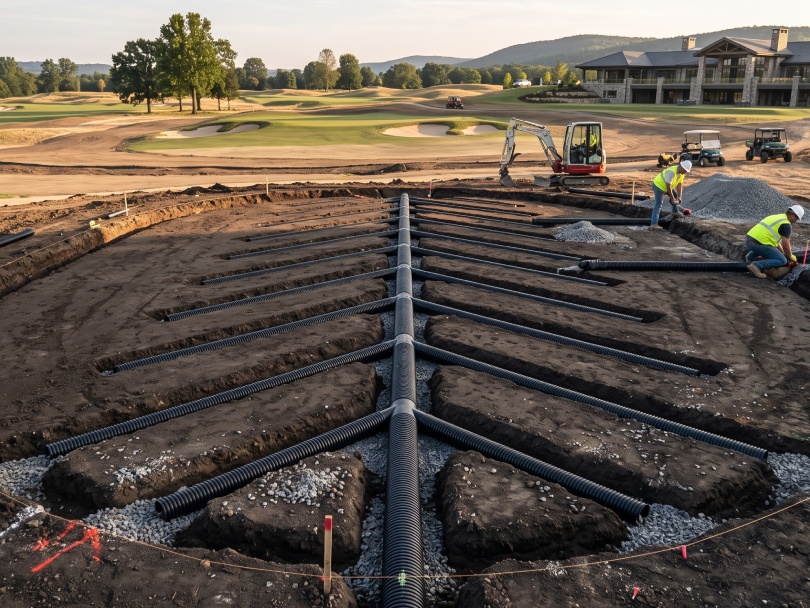
Executing a successful program of USGA specification greens construction requires strict adherence to precise civil layering protocols and material physics. The excavation base is sculpted to match the final surface contours of the green, ensuring uniform subsoil slope angles throughout the profile. Our construction teams lay a continuous 100mm (four-inch) blanket layer of clean, washed gravel across the prepared subgrade base, embedding a main collector pipe network along the primary drainage flow lines. Over this gravel blanket, a precisely blended 300mm (12-inch) rootzone layer—composed of 85% to 90% specific medium-to-coarse sand and 10% to 15% organic soil amendment—is placed and compacted uniformly. This distinct structural transition between the fine rootzone sand and the coarse gravel creates a suspended water table effect, retaining essential capillary moisture in the upper rootzone while forcing excess gravitational water to drain instantly into the gravel blanket.
Hydraulic Mechanics in Subsurface Green Drainage Networks
The operational efficiency of subsurface green drainage systems depends on the rapid movement of free gravitational water through the rootzone matrix into the underlying drainage pipes. NWD Golf installs high-density, perforated HDPE drain pipes in a herringbone pattern across the subgrade floor, spacing lateral lines four to six meters apart to ensure rapid water evacuation. When heavy downpours occur, surface water moves down through the high-permeability sand-rootzone at infiltration rates exceeding 300mm per hour. Water reaching the gravel blanket flows laterally along the subgrade floor straight into the perforated pipe grid, which evacuates stormwater to out-of-play collection vaults immediately. This rapid drainage performance eliminates standing water on the surface within minutes, allowing play to resume instantly without risking turf compaction or mud damage.
Agronomic Chemistry: Formulating High-Performance Sand-Organic Rootzones
Selecting and testing the rootzone mix composition is a critical step in building durable, high-density putting surfaces. Uncertified sand containing excessive silt, clay, or fine particles will pack tightly, clogging pore spaces and destroying drainage capacity over time. NWD Golf mandates rigorous laboratory physical testing of all local sand sources to ensure precise particle size distribution matching USGA physical guidelines. The sand matrix is blended with high-grade sphagnum peat moss or inorganic soil conditioners to establish proper Cation Exchange Capacity (CEC), which allows the soil to hold essential plant nutrients efficiently. This engineered rootzone profile promotes deep, extensive root development, improves nutrient absorption, and allows turfgrass plants to resist mechanical wear and disease pressure naturally.
Managing Capillary Water Action and Subsoil Oxygenation Cycles
A major advantage of a USGA-spec green profile is its ability to balance capillary water retention with continuous rootzone aeration automatically. The interface between the 300mm sand layer and the 100mm gravel layer acts as a physical barrier that holds a thin zone of moisture—the “perched water table”—just above the gravel layer. This capillary moisture reservoir supplies the turf plant’s roots with steady water during dry periods, reducing the need for continuous surface irrigation. As this capillary water is drawn up by the roots or drains away, atmospheric air is pulled down through the sand profile behind it, flushing stale carbon dioxide out of the soil and recharging the rootzone with fresh oxygen. This self-aerating vacuum cycle maintains an ideal 50% solid, 25% air, and 25% water balance in the rootzone, supporting healthy subterranean biology.
Financial Preservation: Preventing Catastrophic Turf Failure and Rebuilds
Investing in professional USGA-spec green construction delivers crucial financial protection for master developers and private club boards. Rebuilding a failed, compacted push-up green complex after a catastrophic summer turf die-off costs tens of thousands of dollars per green in emergency excavation, lost play revenue, and turf re-establishment fees. By building a structurally stable, self-draining USGA profile during initial construction or renovation, facilities eliminate the risk of subterranean soil failure permanently. High-performance greens remain firm, fast, and healthy for over 25 to 30 years with routine aeration, keeping the venue open, protecting green fee revenue, and preserving the club’s international reputation.
NWD Golf: Global Masterminds of High-Performance Putting Surfaces
NWD Golf is the premier global architectural authority on putting green engineering, leveraging 52 years of collective design heritage to master the science of USGA specification greens (H2). Our USP lies in our unique ability to combine heavy civil engineering precision with subtle, artistic green shaping, creating putting complexes that deliver strategic shot values and flawless turf health. The NWD Golf brand is synonymous with advanced subsurface green drainage, ensuring your facility is backed by certified sand testing, precise gravel blanket layering, and automated drainage networks. Our lead architects personally oversee every stage of subgrade excavation, gravel placement, and rootzone shaping, guaranteeing that your landmark putting greens deliver unmatched playability, high operational reliability, and lasting commercial asset value.
Our Specialized Green Construction and Subsoil Engineering Services
Our specialized technical services include complete subsoil hydraulic audits, laboratory sand particle testing, and full-scale engineering layouts for subsurface green drainage (H2) and USGA green complex construction. We work in direct coordination with your course superintendent, civil contractors, and agronomic laboratories to ensure your putting greens meet the highest international standards. NWD Golf provides complete project oversight, from checking subgrade slope angles to calibrating subsurface air induction utilities. As pioneers of high-performance sports architecture, we offer the data-backed design insights needed to turn delicate putting surfaces into your facility’s greatest source of operational stability, commercial distinction, and long-term asset value. Partner with NWD Golf to build putting greens that endure for generations.
What physical layers make up a certified USGA specification putting green profile?
A certified USGA specification putting green profile consists of three main structural layers built over a contoured subgrade base. The lowest layer features a network of perforated HDPE drain pipes set inside trenches along the subgrade floor. Over this base sits a continuous 100mm (four-inch) gravel blanket layer composed of clean, washed gravel meeting specific particle size distribution rules. The top layer is a 300mm (12-inch) engineered rootzone mix made of 85% to 90% graded medium-to-coarse sand blended with 10% to 15% organic peat moss. This layered layout creates a perched water table that retains essential capillary moisture while allowing excess water to drain rapidly into subsurface pipes.
How does the "perched water table" effect work inside a USGA specification green?
The perched water table effect occurs naturally at the structural interface where the fine-textured sand rootzone meets the coarse-textured gravel blanket layer. Because water molecules cling to fine sand particles through capillary force, water will not flow down into the larger pore spaces of the gravel layer until the sand directly above it becomes fully saturated. Once saturation occurs, gravity overcomes capillary tension, pulling excess free water down into the gravel blanket and subsurface pipes. This natural physics barrier holds a steady reserve of capillary moisture in the lower rootzone during dry weather, providing roots with water while keeping the upper playing surface firm, dry, and aerated.
What minimum water infiltration rate is required for a modern USGA rootzone sand mix?
A modern USGA rootzone sand mix is engineered to achieve an initial saturated hydraulic conductivity (water infiltration rate) of 150mm to 300mm (6 to 12 inches) per hour under laboratory testing. This high infiltration rate ensures that putting surfaces can absorb severe torrential downpours without standing water forming on the green. Over years of play, organic matter buildup from decaying turf roots gradually slows infiltration rates slightly, which is why starting with a high-permeability sand matrix is essential. Proper physical sand selection prevents surface ponding, stops mud formation, and allows play to resume immediately after heavy storms.
Why is particle size distribution testing critical when selecting sand for green construction?
Particle size distribution testing is critical because using sand with uncertified or improper particle sizes can lead to severe structural failure of the green. If the sand contains excessive fine particles, silt, or clay (under 0.15mm), these fine materials will fill in soil pore spaces, causing severe compaction, root suffocation, and waterlogging. Conversely, if the sand is too coarse (over 1.0mm), the green will fail to retain capillary moisture and plant nutrients, resulting in weak, drought-prone turf. Laboratory testing ensures the sand matrix features the precise ratio of medium and coarse sand particles needed to maintain ideal pore space, proper drainage, and strong capillary moisture balance.
How does subsurface green drainage prevent toxic black-layer formation in soil profiles?
Subsurface green drainage prevents toxic black-layer formation by keeping the rootzone aerated and preventing long-term anaerobic (oxygen-starved) soil conditions. Black-layer occurs when stagnant, waterlogged soil lacks oxygen, forcing anaerobic bacteria to produce metal sulfides and methane gases that create a dark, foul-smelling layer that kills plant roots. A USGA drainage system evacuates excess gravitational water rapidly after rain, pulling fresh atmospheric air down through the sand pores into the rootzone. This continuous internal air exchange keeps oxygen levels high, suppresses anaerobic bacteria, and maintains a healthy biological soil environment that supports deep root growth.
What is the average operational lifespan of a properly built USGA specification putting green?
A properly engineered and constructed USGA specification putting green features an average operational lifespan of 25 to 30 years before major structural rebuilding is needed. The subterranean components—including the washed gravel blanket, high-density polyethylene drain pipes, and contoured subgrade—are chemically inert and will not degrade over time. To maintain peak performance across this 30-year lifespan, greenkeeping teams must perform routine agronomic care, such as core aeration, sand topdressing, and deep-tine venting, to manage organic thatch accumulation in the upper 50mm of the turf canopy and keep pore spaces open.

Pierfrancesco De Simone is a European Institute-accredited golf architect and engineer known for seamlessly merging ecology with modern strategy. With projects across Europe and Africa, he specialises in water-wise routing and habitat-rich design. At NWD Golf, Pierfrancesco advances sustainable innovation, ensuring every feature—from bunkers to waterways—respects land heritage while inspiring contemporary play.
- Pierfrancesco De Simone
- Pierfrancesco De Simone
- Pierfrancesco De Simone