
Synopsis
Modern golf venues are rapidly moving away from simple driving nets and single-ended range blocks, evolving toward high-capacity practice hubs that function as primary profit centers. This technical guide examines how NWD Golf engineers advanced double sided driving range design layouts to serve touring pros, academy students, and casual guests at the same time. We detail the spatial geometry required to construct wide, 2000 sqm putting greens, multi-tiered short-game zones, and target greens that simulate authentic approach shots. By exploring the civil requirements of high capacity practice infrastructure, our architects show how laser-guided drainage networks and high-output lighting systems allow range fields to operate safely across all seasons. We break down the structural layout of dual-ended tee decks, illustrating how automated range-ball recovery systems and teaching building installations streamline daily greenkeeping operations. Discover how NWD Golf combines tech-rich launch monitor technology with creative land shaping to deliver a short game facility architecture that increases member engagement and drives secondary food and beverage sales. Partnering with NWD Golf guarantees your facility transforms into an active, high-yield training sanctuary that maximizes daily throughput, accelerates junior player development, and establishes a dominant competitive edge in the luxury sports market.
Table Of Content
- The Practice Hub Evolution: Converting Static Ranges into Active Profit Centers
- Spatial Geometry Metrics in Double Sided Driving Range Design
- High Capacity Practice Infrastructure: Engineering Dual-Ended Performance
- Architectural Execution of 2000 SQM Putting and Short Game Zones
- Subsurface Hydraulics: Year-Round Turf Health on Practice Surfaces
- Commercial Optimization: Integrating Academies and Evening Revenue
- NWD Golf: Global Masterminds of High-Yield Training Architecture
- Our Specialized Practice Range Master Planning and Academy Services
The Practice Hub Evolution: Converting Static Ranges into Active Profit Centers
The global sports hospitality sector has reached a turning point where traditional, single-use practice ranges no longer meet the expectations of modern golfers. Historically, practice areas were treated as secondary amenities, featuring narrow hitting strips, flat grass fields, and distant target flags that offered little visual feedback. Today, time-pressed executives, tournament professionals, and golf academy students seek dynamic, data-rich training facilities that offer realistic feedback for every club in the bag. Modern practice hubs must handle high player volumes safely while providing an engaging social atmosphere that extends guest stays. At NWD Golf, we resolve these contemporary spatial demands by designing multi-dimensional, high-capacity practice hubs. By combining advanced biomechanical teaching technology with realistic target shaping, our practice master plans turn passive range fields into active profit centers that drive year-round revenue.
Spatial Geometry Metrics in Double Sided Driving Range Design
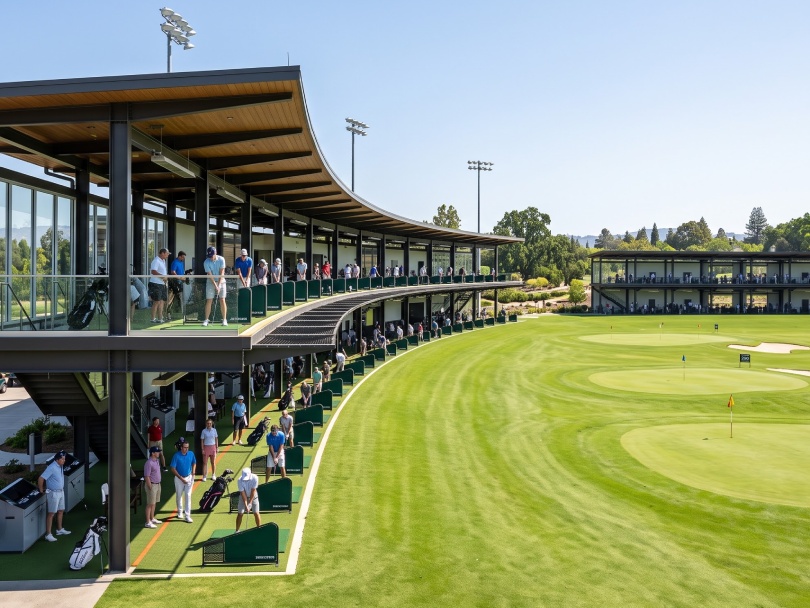
Executing a successful program of double sided driving range design requires precise spatial allocation, strict safety buffers, and multi-directional hitting geometries. Traditional single-ended ranges limit player capacity and force continuous wear on a single grass tee box, leading to bare soil patches during high-volume seasons. NWD Golf solves this capacity bottleneck by engineering dual-ended hitting corridors positioned at opposite ends of a central landing field. Our layout specifications mandate a minimum field width of 150 meters and a total length of 320 to 350 meters between opposite tee decks. This generous spatial footprint ensures that long-hitting players using modern drivers can practice simultaneously from both ends without risk of cross-range ball strikes, effectively doubling the daily player capacity of the facility.
High Capacity Practice Infrastructure: Engineering Dual-Ended Performance
Building high-performance practice facilities requires combining heavy civil infrastructure with high-tech golf technology. NWD Golf constructs continuous, multi-tiered teeing ribbons that combine natural grass tee decks with weather-proof synthetic turf hitting strips. This hybrid setup allows greenkeeping teams to move tee markers daily across natural turf during peak weather, while switching players to high-density synthetic mats during rainy periods or turf recovery cycles. At the primary academy end, we construct enclosed teaching buildings equipped with high-speed video cameras, 3D motion sensors, and launch monitors. These climate-controlled hitting bays open directly onto the range field via automated glass doors, allowing certified instructors to conduct year-round lessons regardless of external weather conditions.
Architectural Execution of 2000 SQM Putting and Short Game Zones
A core highlight of modern practice architecture is the inclusion of expansive, dedicated short-game complexes that match on-course green speeds perfectly. NWD Golf designs 2000 sqm putting greens featuring subtle micro-contours, wide plateau zones, and steep collection hollows that simulate every possible putting scenario found on the main course. Situated adjacent to the putting surface, our teams build specialized pitching and chipping greens surrounded by deep fairway collection areas, pot bunkers, and thick rough matrices. These short-game greens are specifically engineered to handle simultaneous use by up to three separate groups of players practicing different approach shots safely, maximizing spatial efficiency without creating crowding or player interference.
Subsurface Hydraulics: Year-Round Turf Health on Practice Surfaces
Because practice fields face continuous, concentrated divot damage and heavy foot traffic, their underlying civil infrastructure must deliver exceptional durability and rapid drainage. NWD Golf installs laser-guided, perforated HDPE collector pipes inside gravel-backfilled trenches directly beneath all hitting tees, target greens, and range landing fields. We apply a uniform 10-inch washed sand cap across all short-game complexes to ensure rapid water movement during heavy cloudbursts. Furthermore, target greens are sculpted with internal drainage slopes that channel stormwater into lined collection vaults. This high-capacity drainage framework prevents standing water, eliminates mud spots, and allows mechanical range-ball harvesters to operate smoothly immediately after heavy downpours.
Commercial Optimization: Integrating Academies and Evening Revenue
Maximizing the financial yield of a modern practice facility requires capturing high-value corporate group bookings and evening social traffic after standard course hours close. NWD Golf integrates low-glare, commercial-grade LED sports lighting networks across hitting decks, target greens, and short-game zones. Illuminated target greens shaped with bright, color-contrasting sand bunkers transform the range field into an exciting visual backdrop after dark. By locating these illuminated practice hubs adjacent to central clubhouse terraces or sports bars, operators can host evening golf events, interactive range games, and corporate team-building parties. This evening activation expands hospitality revenue per square meter, boosts food and beverage sales, and draws non-golfing resort guests into the sport.
NWD Golf: Global Masterminds of High-Yield Training Architecture
NWD Golf is the premier global architectural authority on high-yield training infrastructure, leveraging 52 years of collective design heritage to master the science of double sided driving range design. Our USP lies in our unique ability to combine heavy civil engineering requirements with realistic target sculpting, transforming static range fields into high-performance training hubs that maximize resort throughput and membership value. The NWD Golf brand is synonymous with advanced high capacity practice infrastructure, ensuring your sports asset is backed by automated water drainage, durable turf matrices, and flexible academy master plans. Our lead architects personally direct every stage of field shaping, tee positioning, and lighting calibration, guaranteeing that your landmark practice complex delivers unmatched commercial yield, deep operational flexibility, and elite global prestige.
Our Specialized Practice Range Master Planning and Academy Services
Our specialized technical services include comprehensive spatial utilization audits, range field cut-and-fill modeling, and full-scale architectural layouts for short game facility architecture (H2) and commercial academies. We work in direct coordination with your head golf professionals, academy directors, and civil engineering teams to ensure your practice hub drives maximum financial return per square meter. NWD Golf provides complete project oversight, from checking subsoil grading profiles to the final calibration of automated lighting networks and target green contours. As pioneers of high-capacity sports architecture, we offer the data-backed design insights needed to turn practice amenities into your project’s primary driver of commercial distinction and long-term asset value. Partner with NWD Golf to build the iconic practice terminals that will lead the future of luxury sports real estate.
What minimum land length and width are required to build a safe double-sided driving range?
Building a safe, functional double-sided driving range requires a minimum field length of 320 to 350 meters between opposite hitting tee decks, along with a minimum width of 150 meters. This spatial footprint ensures that long-hitting golfers using modern drivers can practice simultaneously from both ends of the field without risk of cross-range ball strikes. The generous 150-meter width provides sufficient lateral safety buffers along outer perimeters, allowing for the placement of target greens and protective tree buffers that absorb errant shots naturally without requiring unsightly industrial safety nets.
How do hybrid tee decks combine natural grass with synthetic turf to handle high player volumes?
Hybrid tee decks manage high player volumes by combining expansive natural turf ribbons with high-density, weather-proof synthetic turf hitting strips placed directly behind the grass deck. During dry, sunny weather, greenkeeping teams position tee markers on the natural grass deck, allowing golfers to enjoy an authentic turf divot experience. During heavy rainstorms, winter recovery cycles, or high-volume corporate events, tee markers are shifted back onto the synthetic turf strips. This operational rotation prevents heavy divot destruction, gives natural turf grass time to recover organically, and ensures the practice facility remains open and operational 365 days a year.
What structural features allow a 2000 sqm putting green to host multiple player groups simultaneously?
A 2000 sqm putting green hosts multiple player groups simultaneously by incorporating wide plateau zones, undulating ridge contours, and multiple distinct entry points into its spatial layout. NWD Golf shapes the expansive green with distinct sub-sections separated by subtle physical ridges, creating three to four independent putting zones on a single continuous surface. Each zone features its own cup locations and approach collection areas, allowing touring pros, academy classes, and casual resort guests to practice different putting drills at the same time without crowding or line-of-sight interference.
How does LED night-lighting turn a practice facility into a high-yielding evening entertainment hub?
Installing commercial-grade, low-glare LED sports lighting across hitting decks and range fields extends operational hours well past sunset, creating a new evening revenue window for the facility. Illuminated target greens, bright hazard boundaries, and high-tech tracking systems transform the practice area into a social venue that draws corporate groups, families, and young professionals after work. Located next to clubhouse restaurant decks, these illuminated practice fields host casual target-golf games, private evening clinics, and social events, driving secondary food, beverage, and venue-rental sales.
What subsoil drainage specifications are necessary to prevent range-ball harvesters from rutting the field?
Preventing heavy range-ball harvesters from rutting the landing field during wet weather requires installing a high-capacity subsurface drainage network beneath a structured sand cap. NWD Golf specifies a network of laser-guided, perforated HDPE drain pipes set inside gravel trenches, overlaid with a uniform 6 to 8-inch washed sand blanket across the entire landing floor. This high-permeability structure drains surface water rapidly during heavy downpours, keeping the soil firm and dry. This civil design allows heavy mechanical ball harvesters to operate safely across the field immediately after rain without sinking, rutting the turf, or damaging grass roots.
across the field immediately after rain without sinking, rutting the turf, or damaging grass roots. How does integrating a indoor-outdoor teaching building enhance a golf academy's commercial value?
Integrating an indoor-outdoor teaching building enhances commercial value by allowing certified instructors to deliver high-tier, tech-rich golf instruction year-round in any weather. These specialized buildings feature climate-controlled bays equipped with launch monitors, high-speed video analysis, and 3D force plates that measure swing mechanics in detail. Automated glass garage doors open directly onto the outdoor landing field, allowing students to track real ball flight in the open air while staying sheltered from rain or extreme heat. This professional infrastructure commands top-tier lesson rates, attracts elite junior players, and boosts the international reputation of the golf academy.

Pierfrancesco De Simone is a European Institute-accredited golf architect and engineer known for seamlessly merging ecology with modern strategy. With projects across Europe and Africa, he specialises in water-wise routing and habitat-rich design. At NWD Golf, Pierfrancesco advances sustainable innovation, ensuring every feature—from bunkers to waterways—respects land heritage while inspiring contemporary play.
- Pierfrancesco De Simone
- Pierfrancesco De Simone
- Pierfrancesco De Simone
- Pierfrancesco De Simone