
Synopsis
Sand bunkers represent one of the most high-overhead, labor-intensive liabilities on a modern golf course, frequently suffering from structural edge breakdown, sand contamination, and severe washout after heavy rains. This blog post examines how NWD Golf deploys advanced low-input hazard engineering frameworks to eliminate structural hazard failures permanently. We detail the mechanical setup of EcoBunker stacked synthetic turf edges, demonstrating how engineered revetments prevent edge erosion and eliminate manual edging labor. Our guide explores the hydraulic performance of SoftBunker aggregate liner systems, showing how high-permeability subterranean barriers lock clean sand in place while accelerating water evacuation into subsurface drainage pipes. By flattening surrounding turf slopes to allow mechanical mowing, our architects help club managers reduce annual bunker maintenance expenditures by up to 50%. Discover how NWD Golf combines cutting-edge geotechnical liner technology with artistic hazard shaping to create visual depth and strategic challenge without financial overhead. Partnering with NWD Golf equips your sports facility with unyielding, weather-proof hazard structures that maintain crisp, tournament-grade aesthetics and pristine playability through intense seasonal downpours.
Table Of Content
- The High-Cost Liability: Rethinking Traditional Golf Course Hazard Upkeep
- Structural Revetment Engineering: The Mechanics of EcoBunker Technology
- Hydraulic Filtration and Stabilization: Performance of SoftBunker Liner Systems
- Slope Contouring and Mechanical Mowing: Eliminating High-Cost Hand Labor
- Subsurface Hydraulics: Integrating High-Capacity Hazard Drainage Grids
- Long-Term Financial ROI: Slashing Upkeep Budgets and Sand Replacement
- NWD Golf: Global Leaders in High-Efficiency Hazard Architecture
- Our Specialized Hazard Engineering and Bunker Renovation Services
The High-Cost Liability: Rethinking Traditional Golf Course Hazard Upkeep
Across the global sports real estate sector, sand hazards represent a major operational headache for greenkeeping teams and course superintendents. Traditional soil-backed bunkers are built with natural grass edges and exposed earth bases, leaving them highly vulnerable to mechanical breakdown, water erosion, and contamination. During heavy rainstorms, rainwater rushes down steep bunker faces, washing mud and silt straight into the sand matrix. This contamination destroys sand porosity, causes standing water, and forces maintenance crews to spend hundreds of hours shoveling, pumping out water, and replacing ruined sand. Furthermore, natural turf edges require continuous hand-trimming and edging to prevent invasive grass from creeping into the hazard. At NWD Golf, we address these operational liabilities by deploying low-input hazard engineering systems that stabilize hazard structures permanently, ensuring immaculate playing conditions while cutting maintenance labor in half.
Structural Revetment Engineering: The Mechanics of EcoBunker Technology
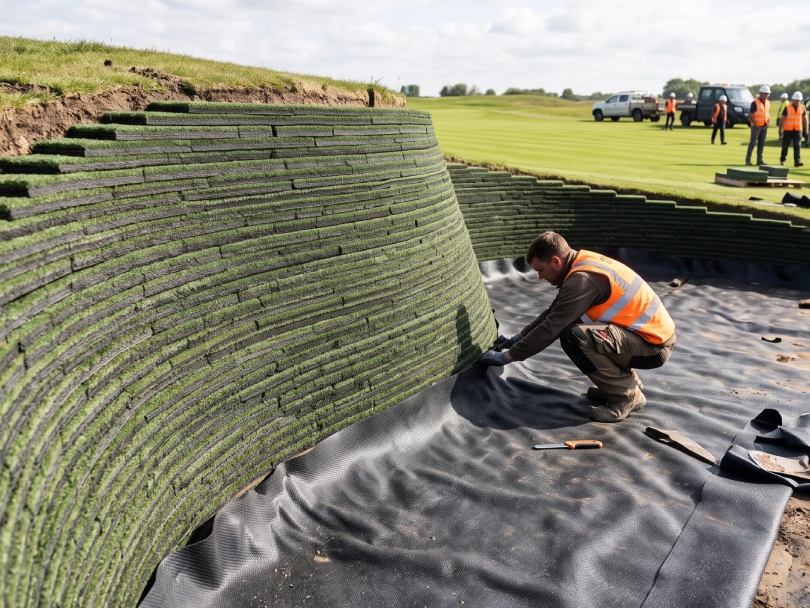
Executing a permanent fix for bunker edge failure requires replacing fragile natural turf edges with engineered revetment materials that resist soil breakdown and heavy foot traffic. NWD Golf utilizes EcoBunker technology, an advanced construction system that builds bunker edges using stacked layers of recycled synthetic turf. Our construction teams lay these synthetic turf tiles in a tightly interlocked, stepped arrangement, backfilling them with compacted aggregate or specialized concrete bindings. This structural revetment creates an unyielding, naturalistic bunker wall that maintains its crisp, sharp edge profile indefinitely. Synthetic edges never rot, collapse, or suffer from soil erosion, completely insulating the hazard face from weather damage and eliminating the need for routine hand-edging or turf repair.
Hydraulic Filtration and Stabilization: Performance of SoftBunker Liner Systems
While synthetic edges protect the vertical walls of a hazard, protecting the flat floor and sloped base requires a high-performance subterranean barrier system. NWD Golf integrates SoftBunker liner technology across the excavated base of every hazard profile. The SoftBunker system consists of a flexible, porous aggregate layer that covers the underlying soil base completely before clean bunker sand is added. This structural liner acts as a high-velocity hydraulic filter: rainwater passes straight through the sand and liner into subsurface drainage pipes, while mud, rocks, and subsoil silt are blocked from rising into the sand. By locking the clean bunker sand onto sloped hazard faces, SoftBunker liners prevent sand washouts during severe storms, keeping hazards tournament-ready with minimal manual intervention.
Slope Contouring and Mechanical Mowing: Eliminating High-Cost Hand Labor
A major portion of annual bunker upkeep expenses stems from hand-mowing the steep grass slopes and mounds surrounding traditional hazard complexes. When surrounding turf slopes exceed steep angles, heavy ride-on mowers cannot operate safely, forcing maintenance staff to rely on hand-held string trimmers or walk-behind mowers. NWD Golf resolves this operational inefficiency during the architectural design phase by reshaping surrounding turf slopes to gentle, organic gradients. By keeping surrounding slopes below 25-degree angles, large commercial ride-on mowers can groom the turf right up to the synthetic EcoBunker edge safely. This simple adjustment eliminates manual hand-trimming labor completely, allowing greenkeeping teams to redirect valuable labor toward critical putting surface management.
Subsurface Hydraulics: Integrating High-Capacity Hazard Drainage Grids
The long-term performance of an engineered hazard complex depends heavily on the hydraulic capacity of the underlying subsurface drainage pipe network. SoftBunker liners rely on an active drainage system beneath the floor to carry intercepted rainwater away before water pressure can build up beneath the sand. NWD Golf installs laser-guided, perforated HDPE collector pipes inside gravel-backfilled trenches directly beneath the liner matrix. These pipes connect straight to primary course drainage lines or nearby water retention lakes. This high-capacity drainage setup evacuates stormwater at rapid velocities, preventing sand saturation and standing water even during heavy cloudbursts. This subsurface drainage performance allows players to enter hazards safely and hit clean shots immediately after storm events.
Long-Term Financial ROI: Slashing Upkeep Budgets and Sand Replacement
Investing in advanced low-input hazard engineering delivers immediate, measurable financial returns by cutting annual maintenance labor and sand replacement costs. Traditional sand hazards require complete sand replacement every three to five years due to severe soil contamination and organic degradation, costing clubs tens of thousands of dollars in material and transport fees. By pairing EcoBunker synthetic edges with SoftBunker liners, the sand matrix remains completely isolated from underlying soil and collapsing edges, extending sand usability to over fifteen years. Combined with the elimination of hand-mowing labor, golf facilities cut annual hazard maintenance costs by up to 50%, providing an aggressive internal rate of return that repays the initial renovation investment within three to four seasons.
NWD Golf: Global Leaders in High-Efficiency Hazard Architecture
Every forward-thinking golf facility built for the modern economy relies on specialized design groups capable of combining high-stakes athletic aesthetics with civil engineering efficiency. NWD Golf stands as the premier global architectural authority on low-maintenance hazard design, merging 52 years of collective design heritage with the latest geotechnical liner and revetment technologies. The NWD Golf brand is synonymous with low-input hazard engineering, ensuring your sports asset functions as a visually stunning, weather-proof feature that maximizes daily venue throughput. Our lead architects personally direct every phase of hazard shaping, liner installation, and slope contouring, guaranteeing a perfect balance of artistic hazard placement, player challenge, and long-term operational efficiency.
Our Specialized Hazard Engineering and Bunker Renovation Services
Our specialized hazard engineering services include full-scale bunker audits, subsoil hydraulic profiling, and complete installation layouts for EcoBunker synthetic edges and SoftBunker liner systems. We work in direct coordination with course superintendents, civil contractors, and club boards to ensure your hazard renovation integrates cleanly with existing drainage grids and budget parameters. NWD Golf provides complete project management, from checking subsoil soil properties to supervising synthetic edge installation. As pioneers of low-input hazard design, we offer the data-backed insights needed to turn high-overhead hazard liabilities into your facility’s greatest source of operational savings and visual prestige. Partner with NWD Golf to modernize your hazards and secure lasting financial strength for your golf property.
How does EcoBunker technology physically prevent golf course bunker edge erosion?
EcoBunker technology prevents bunker edge erosion by replacing fragile, natural turf edges with stacked, interlocked layers of recycled synthetic turf tiles. Traditional soil edges breakdown over time due to weather exposure, heavy rain, and mower damage, washing mud down into the sand face. The synthetic EcoBunker tiles are laid in a dense, stepped revetment wall anchored into compacted backfill or concrete aggregate bindings. This creates a permanent, structurally stable wall that never decays, dries out, or collapses under foot traffic. By stabilizing the edge structure permanently, the hazard retains its sharp, artistic outline without requiring routine hand-edging or turf repairs.
What material composition gives SoftBunker liner systems their high-permeability filtering capability?
SoftBunker liner systems utilize a specialized, porous aggregate matrix blended with synthetic binding agents to form a continuous, seamless subsoil barrier beneath the bunker sand. This engineered structure features high internal macro-porosity that allows rainwater to pass straight down through the liner into subsurface drainage pipes at rapid velocities. At the same time, the physical density of the liner blocks underlying soil particles, mud, and rocks from migrating upward into the sand matrix. This dual filtration capability locks clean sand onto steep bunker faces, prevents mud contamination, and keeps the hazard dry and playable immediately after heavy rains.
How does reducing the steepness of surrounding bunker slopes eliminate hand-mowing labor?
Reducing the steepness of surrounding bunker turf slopes eliminates hand-mowing labor by allowing greenkeeping crews to groom the turf using large, ride-on commercial mowers safely. When surrounding mounds feature steep gradients over 30 degrees, ride-on mowers risk tipping over, forcing crews to use handheld string trimmers or walk-behind mowers, which inflates labor hours significantly. During the design phase, NWD Golf shapes surrounding mounds to gentle, smooth gradients below 25 degrees. This enables commercial mowers to cut the turf right up to the EcoBunker synthetic edge safely, eliminating manual hand-trimming labor and lowering annual maintenance expenses.
Can EcoBunker synthetic edges and SoftBunker liners be retrofitted into existing bunkers without full course reconstruction?
Yes, EcoBunker synthetic edges and SoftBunker liners can be retrofitted easily into existing bunker complexes as a standalone renovation project without disrupting the broader course routing. The process involves excavating the old, contaminated sand and soil base of the existing hazard, reshaping the internal slopes, and installing new subsurface drainage pipes. Our construction teams then build the synthetic EcoBunker revetment edge along the perimeter and lay the SoftBunker liner matrix across the floor before adding fresh bunker sand. This modular renovation process allows clubs to upgrade hazards in phases during off-peak seasons, minimizing course downtime while delivering immediate operational savings.
How long is the expected structural lifespan of an EcoBunker and SoftBunker hazard installation?
An engineered hazard installation utilizing EcoBunker synthetic edges and SoftBunker liners features an expected structural lifespan exceeding 15 to 20 years without requiring major rebuilding. Traditional soil-backed bunkers typically fail within three to five years due to edge breakdown, mud contamination, and sand erosion, forcing expensive sand replacement and structural repair. Because synthetic EcoBunker tiles are UV-stabilized and chemically inert, they do not decay or degrade under intense sunlight or frost cycles. Similarly, the durable SoftBunker liner matrix prevents soil intrusion indefinitely, keeping the bunker sand clean, bright, and playable for decades.
What overall reduction in annual maintenance budgets can a golf course expect after renovating its hazards with NWD Golf?
A golf course renovating its hazards with NWD Golf can expect an overall reduction in annual bunker maintenance budgets of up to 50%. This financial saving is achieved through three key mechanisms: the complete elimination of hand-edging labor along synthetic EcoBunker walls, the removal of hand-mowing labor through gentler slope contouring, and the elimination of frequent sand replacement expenses thanks to SoftBunker contamination barriers. Additionally, greenkeeping crews spend far less time repairing washouts or pumping standing water out of hazards after severe storms, allowing management to reallocate labor resources toward optimizing green and fairway performance.

Pierfrancesco De Simone is a European Institute-accredited golf architect and engineer known for seamlessly merging ecology with modern strategy. With projects across Europe and Africa, he specialises in water-wise routing and habitat-rich design. At NWD Golf, Pierfrancesco advances sustainable innovation, ensuring every feature—from bunkers to waterways—respects land heritage while inspiring contemporary play.
- Pierfrancesco De Simone
- Pierfrancesco De Simone
- Pierfrancesco De Simone