
Synopsis
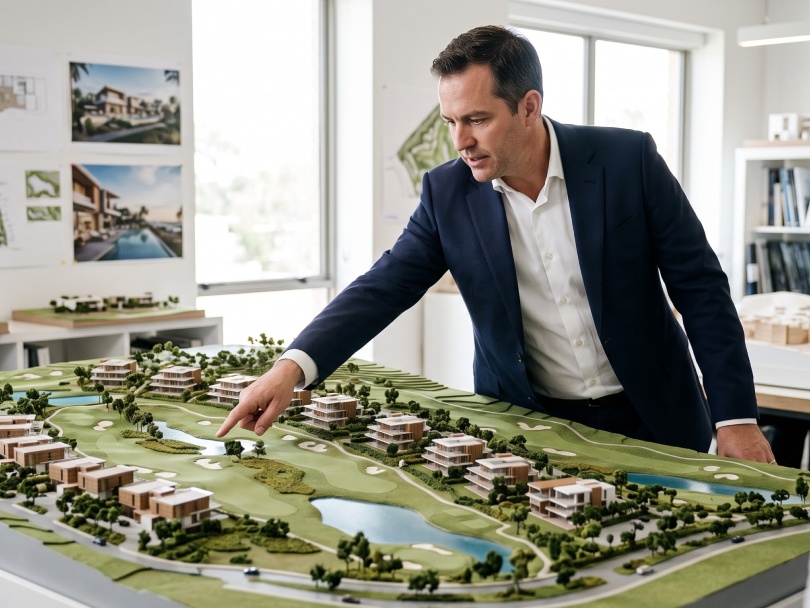
Integrating a championship golf course into a multi-use resort master plan requires balancing athletic design integrity with high-yield residential real estate positioning. This technical guide explores how NWD Golf executes master planned real estate routing to maximize linear fairway frontage while maintaining strict safety buffers. We detail how strategic corridor orientation, single-loaded fairway loops, and integrated landscape mounding allow developers to command up to a 40% pricing premium on villa plots. By coordinating civil infrastructure early in the schematic design phase, our master planners reduce heavy earthmoving costs, optimize utility distribution, and establish seamless spatial connectivity between residential neighborhoods, hotel amenities, and central clubhouses. Discover how NWD Golf combines advanced digital ball-flight dispersion modeling with creative land shaping to deliver a high-yield resort framework that turns open green spaces into the primary financial engine for adjacent real estate sales. Partnering with NWD Golf ensures your master plan transforms from a traditional land development project into a world-class lifestyle destination that secures accelerated capital returns, elevated home plot values, and lasting brand equity across global luxury property markets.
Table Of Content
- The Real Estate Multiplier: Aligning Sports Architecture with Property Valuation
- Spatial Routing Mechanics: Maximizing Linear Fairway Frontage
- Safety Envelope Geometry: Ball-Flight Dispersion and Hazard Placement
- Structural Integration: Civil Utility Coordination and Earthmoving Efficiency
- Landscape Architecture: Natural Screening and Privacy Buffer Systems
- Financial ROI: Accelerating Sales Velocity and Real Estate Margins
- NWD Golf: Global Masterminds of High-Yield Resort Master Planning
- Our Specialized Master Planning and Real Estate Routing Services
The Real Estate Multiplier: Aligning Sports Architecture with Property Valuation
In modern resort development, a championship golf course serves a dual purpose: it operates as a premier athletic facility and functions as a powerful visual engine that drives adjacent real estate values. Historically, golf courses were designed as isolated 18-hole loops with little regard for how fairway perimeters interacted with surrounding residential land banks. This disconnected approach resulted in vast amounts of underutilized land, poor villa views, and lost real estate revenue. Modern master developers recognize that the financial success of a multi-use resort project depends on maximizing the total linear contact between high-value residential plots and manicured green spaces. At NWD Golf, we align sports architecture directly with real estate development goals, creating integrated master plans that elevate property values while preserving the strategic integrity of the course.
Spatial Routing Mechanics: Maximizing Linear Fairway Frontage
Executing a successful program of master planned real estate routing requires moving past traditional double-loop course layouts into multi-directional, single-loaded playing corridors. Traditional “core” golf courses group 18 holes closely together inside a central green envelope, leaving homes positioned far away along the outer edges of the property. NWD Golf replaces these dense configurations by designing looping, outward-stretching fairway fingers that weave directly through residential communities. By deploying single-loaded fairway corridors—where luxury home sites border one side of the fairway while natural wilderness or secondary play corridors sit on the other—we double the total linear footage of prime fairway frontage. This layout strategy ensures that a significantly higher percentage of real estate plots enjoy unobstructed, panoramic views of manicured fairways, water hazards, and green complexes.
Safety Envelope Geometry: Ball-Flight Dispersion and Hazard Placement
A major concern for developers building homes adjacent to fairways is protecting residential properties from errant golf ball strikes without installing unsightly industrial safety netting. NWD Golf resolves this spatial challenge by utilizing digital ball-flight simulation software and multi-decadal player hit dispersion data during the routing phase. We establish generous, mathematically verified safety buffers—typically 45 to 60 meters from the fairway centerline—along all residential borders. Furthermore, our architects place strategic hazards, land mounding, and dense native tree corridors at specific landing zones to absorb errant shots naturally. By angling tee boxes slightly away from home sites and using natural terrain elevations to guide ball flights, we create a secure living environment where homeowners enjoy front-row views of the game with complete peace of mind.
Structural Integration: Civil Utility Coordination and Earthmoving Efficiency
Coordinating golf course routing with civil infrastructure planning early in the schematic design phase provides massive savings in initial construction and utility installation costs. When golf course shaping, road networks, and residential utility grids are designed independently, developers often face redundant earthmoving, deep sewer trenching, and conflicting stormwater paths. NWD Golf integrates fairway grading directly with master site earthmoving plans. We utilize mass cut-and-fill balancing software to ensure that earth excavated from golf course retention lakes is repurposed immediately to raise adjacent residential building pads above flood levels. Furthermore, primary irrigation mains, fiber-optic lines, and electrical conduits are routed inside shared utility corridors along fairway edges, drastically cutting infrastructure installation costs.
Landscape Architecture: Natural Screening and Privacy Buffer Systems
Balancing breathtaking fairway vistas with personal residential privacy requires a sophisticated landscape architecture strategy. Homeowners demand clear, open views of manicured turf and water features, but they also require protection from the gaze of passing golfers and maintenance crews. NWD Golf solves this layout balance by sculpting multi-tiered landscape buffers along villa property lines. We place low-profile, undulating turf mounds along the fairway edges and plant layers of native flowering shrubs, ornamental grasses, and feather-top palms behind them. This multi-layered planting strategy conceals patio spaces and private swimming pools from the fairway while keeping the open view toward the green unobstructed from inside the home.
Financial ROI: Accelerating Sales Velocity and Real Estate Margins
The financial return on investment of a professionally routed real estate golf master plan is reflected in accelerated plot absorption rates and higher sales margins per square meter. Luxury home buyers in international resort markets consistently pay a 30% to 40% pricing premium for properties offering direct fairway frontage compared to interior, land-locked plots. By optimizing the spatial routing to increase total frontage plots, developers expand their gross real estate revenue potential by millions of dollars. Furthermore, the presence of an eco-certified, beautifully integrated championship golf course establishes an ultra-luxury brand identity for the entire resort, accelerating initial real estate pre-sales and securing long-term property value appreciation.
NWD Golf: Global Masterminds of High-Yield Resort Master Planning
Creating a high-yield resort master plan that merges athletic distinction with maximum real estate value demands an architectural firm with proven global expertise, civil engineering capabilities, and deep spatial tracking technology. NWD Golf stands as the preeminent global authority on real estate golf routing, leveraging 52 years of collective architectural heritage across world-renowned resort developments. The NWD Golf brand is synonymous with fairway frontage optimization, ensuring your land bank functions as a highly profitable, structurally sound real estate ecosystem that leads the global property market. Our lead architects personally oversee every phase of spatial routing, safety mapping, and civil coordination, guaranteeing a seamless blend of luxury lifestyle aesthetics and commercial success.
Our Specialized Master Planning and Real Estate Routing Services
Our specialized master planning services include complete real estate yield audits, digital ball-flight safety mapping, schematic civil utility coordination, and full-scale golf course routing for luxury resort communities. We work in direct coordination with master developers, civil engineering teams, and real estate sales groups to ensure your project generates maximum financial return per acre. NWD Golf provides total development oversight, from checking subsoil grading profiles to supervising landscape buffer installations. As pioneers of high-yield resort architecture, we offer the data-driven design insights needed to turn open land banks into your project’s greatest source of commercial performance, residential prestige, and long-term asset value. Partner with NWD Golf to unlock the full value of your real estate portfolio.
How does closed-loop wastewater irrigation function on a remote island golf course?
Closed-loop wastewater irrigation operates by taking 100% Treated Sewage Effluent (TSE) supplied from local municipal treatment facilities and recycling it into a self-contained, high-efficiency irrigation network. Raw wastewater enters lined retention reservoirs where bio-wetland reed beds, solar aeration, and organic sand filtration extract suspended solids, nitrites, and excess organic compounds naturally. The purified water is then distributed across target fairway and green rootzones through automated, computerized smart irrigation systems during night hours. This circular water framework eliminates reliance on municipal drinking water or desalination, ensuring continuous turf health while protecting local water tables from depletion.
Why is Seashore Paspalum the preferred turfgrass cultivar for arid island golf agronomy?
Seashore Paspalum (Paspalum vaginatum) is the premier turfgrass cultivar for arid island agronomy because of its extreme halophytic, salt-tolerant properties. The grass plant possesses specialized physiological salt-excreting stomata that allow it to thrive when irrigated with brackish water or exposed to continuous oceanic salt spray. It maintains deep root structures, vibrant green coloration, and tight turf density under high-salinity conditions where conventional grasses fail. Additionally, Seashore Paspalum provides exceptional ball roll on greens and rapid recovery from foot traffic wear, delivering tournament-quality playing surfaces with non-potable water.
How does subterranean sand capping prevent capillary salt intrusion in volcanic island soils?
Subterranean sand capping prevents capillary salt intrusion by placing a uniform blanket layer of washed, coarse-graded marine sand over a stabilized subgrade foundation. In ocean island environments, hyper-saline groundwater rises through porous volcanic rock and soil via capillary action, poisoning upper rootzones. Installing a four-to-six-inch sand cap isolates the developing root system from underlying salty subsoils. Combined with subsurface drainage pipes and impermeable membrane barriers in low-lying zones, rainwater and irrigation flush accumulated salts down through the porous sand cap, preventing soil capping and keeping the rootzone biologically active.
Can a resort course operating on 100% recycled water meet international tournament conditioning standards?
Yes, a resort course operating on 100% recycled water can meet and exceed international tournament conditioning standards when supported by proper bio-filtration and salt-hardened turf cultivars. Facilities like Viveiro Golf Resort host flagship events such as the Sal Independence Cup by maintaining immaculate fairway density and fast green speeds using recycled water. Automated bio-wetlands and sand filtration remove harmful impurities from municipal wastewater before irrigation, while Seashore Paspalum turf absorbs organic nutrients efficiently. This combination produces firm, fast, and visually vibrant playing surfaces that meet strict professional tour expectations.
How does native tropical landscaping reduce overall irrigation demand across a golf resort master plan?
Native tropical landscaping reduces irrigation demand by compressing managed turfgrass corridors strictly to active playing zones—such as fairways, tees, and greens—while surrounding out-of-play roughs with native, drought-tolerant flora. Planting indigenous island succulents, wild groundcovers, and local tropical trees creates attractive natural hazards that require zero supplemental irrigation once established. This spatial compression cuts total irrigated turf acreage by up to 50%, dramatically reducing total daily water volumes, pumping energy usage, and mechanical maintenance labor across the estate.
What environmental protection measures prevent irrigation runoff from damaging surrounding marine ecosystems?
Protecting fragile marine ecosystems from irrigation runoff requires lining all retention reservoirs, bio-swales, and low-lying drainage basins with durable, impermeable geomembrane liners. These liners block water containing organic fertilizers or salts from leaching down into coastal groundwater or migrating into ocean bays. Additionally, vegetated bio-swales and sand filters slow down stormwater runoff, filtering nutrients organically before water reaches holding ponds. This self-contained drainage setup ensures zero chemical discharge enters surrounding coral reefs and coastal habitats, helping island resorts secure prestigious global environmental certifications.

Pierfrancesco De Simone is a European Institute-accredited golf architect and engineer known for seamlessly merging ecology with modern strategy. With projects across Europe and Africa, he specialises in water-wise routing and habitat-rich design. At NWD Golf, Pierfrancesco advances sustainable innovation, ensuring every feature—from bunkers to waterways—respects land heritage while inspiring contemporary play.
- Pierfrancesco De Simone
- Pierfrancesco De Simone
- Pierfrancesco De Simone