
Synopsis
Low-lying maritime developments are increasingly exposed to extreme weather risks, making structural durability a primary investment parameter. This technical guide examines how NWD Golf implements shoreline stabilization design systems to protect high-value beachfront fairways from wave-driven erosion and tidal collapse. We explore the architectural mechanics of climate resilient coastal golf, showing how multi-tiered living buffers, offshore artificial reefs, and native mangrove pockets absorb ocean surges organically. By detailing the subsoil requirements of sea level rise adaptation, our engineering teams demonstrate how to install invisible check-valve drainage grids that block marine groundwater from backing up into the rootzone. We break down the civil engineering parameters of beachfront golf engineering, outlining how to manage subsoil salinity while maintaining pristine, high-density putting surfaces year-round. Our analysis explores the principles of island golf architecture, showing how routing fairways as protective outer boundaries shields high-value interior real estate villas from flooding. Discover how NWD Golf crafts marine resilient fairways that transform vulnerable coastal margins into highly secure, long-lasting ecological shields. Partnering with NWD Golf ensures that your luxury coastal property transforms from a vulnerable environmental liability into an unyielding, high-yielding sports landmark that maintains premium playability and majestic oceanfront aesthetics through generations of oceanic volatility.
Table Of Content
- The Maritime Exposure Matrix: Protecting Oceanfront Sports Assets
- Living Hydrodynamics: The Core Principles of Shoreline Stabilization Design
- Structural Frameworks for High-Yield Climate Resilient Coastal Golf
- Subterranean Defense: Mechanics of Sea Level Rise Adaptation
- Advanced Geotechnical Metrics in Beachfront Golf Engineering
- Spatial Shielding: Defensive Strategies in Island Golf Architecture
- NWD Golf: Global Masterminds of Resilient Maritime Sports Real Estate
- Our Specialized Coastal Engineering and Marine Agronomy Services
The Maritime Exposure Matrix: Protecting Oceanfront Sports Assets
The financial reality of developing luxury sports assets along oceanfront margins involves managing a highly volatile environmental boundary. Sprawling seaside resorts command high real estate premiums, yet they face immediate structural risks from severe storm surges and shifting maritime water tables. Passive coastal layouts built under older templates frequently suffer from rapid shoreline recession and salt-water poisoning of the turfgrass. To prevent these failures, forward-thinking master developers are abandoning traditional parkland engineering templates in favor of adaptive, marine-first infrastructure foundations. These modern setups build long-term structural defense into the landscape, ensuring the golf course serves as a protective shield for the entire hospitality ecosystem. This defensive layout turns a beautiful amenity into a vital civil asset that preserves the underlying value of the surrounding coastal property portfolio.
Living Hydrodynamics: The Core Principles of Shoreline Stabilization Design
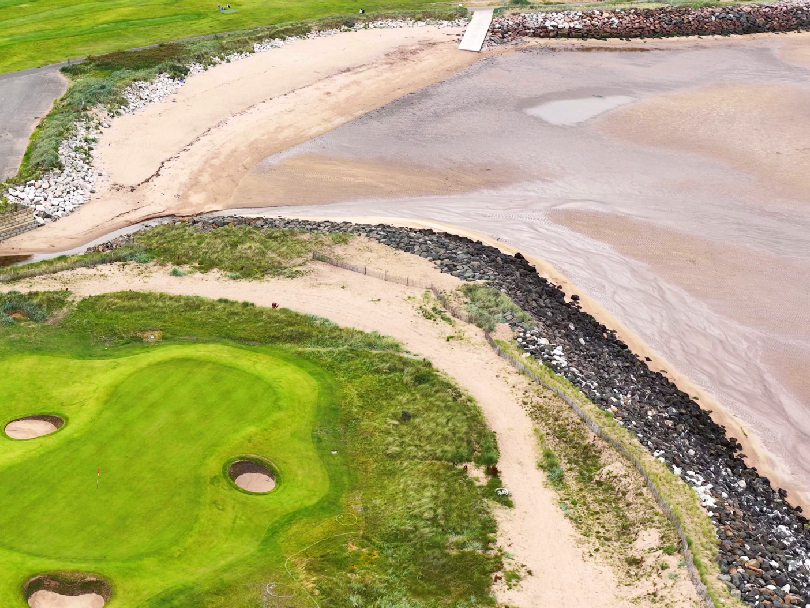
Executing a successful program of shoreline stabilization design requires moving away from traditional, rigid concrete seawalls that destroy the natural beach aesthetic and accelerate down-drift erosion. Modern civil marine engineering proves that hard vertical barriers reflect incoming wave energy straight downward, which rapidly under-scours the sand foundation. Our teams design multi-tiered, living shorelines that copy the wave-damping geometry of natural coastal ecosystems to stabilize the active playing margins permanently. This layout involves building submerged offshore artificial reefs to break heavy deep-water ocean swells far away from the active playing fairways. Behind these offshore breaks, we sculpt wide coastal dune matrices anchored by deep-rooted, native halophytic vegetation and strategic mangrove pockets. This flexible barrier absorbs heavy storm impacts organically, trapping sand and building land mass over time while creating beautiful marine resilient fairways along the hazard boundary.
Structural Frameworks for High-Yield Climate Resilient Coastal Golf
Constructing a high-performance climate resilient coastal golf property requires a complete departure from standard inland design and drainage practices. Seaside fairways must be engineered to function as high-capacity hydrological buffers capable of absorbing severe saltwater wash without suffering turf mortality or structural soil collapse. Our design strategy shapes the coastal holes with protective, outward-sloping safety berms and deep, sand-packed hollows designed as active retention basins during severe storm events. These specialized basins intercept and slow down incoming marine water, preventing tidal flows from penetrating high-value residential development zones. By choosing advanced, salt-hardened turfgrass cultivars that survive temporary marine submersion, we guarantee that the playing envelopes remain stable throughout volatile seasonal weather patterns. This robust design approach yields marine resilient fairways that transform the outer margins of the estate into a functional environmental filter that protects the entire community.
Subterranean Defense: Mechanics of Sea Level Rise Adaptation
The subterranean execution of comprehensive sea level rise adaptation templates focuses heavily on managing the shifting brackish water tables beneath low-lying green complexes. As ocean levels gradually fluctuate, high-salinity groundwater is forced upward into the sandy rootzone through subterranean capillary action, causing rapid root rot. Our technical blueprints resolve this hidden subsurface hazard by installing specialized, multi-layered impermeable membrane liners directly beneath all low-lying putting surfaces. This structural barrier is paired with an automated, positive-pressure subsoil drainage grid equipped with mechanical check-valves that allow freshwater irrigation to exit the green matrix rapidly. Concurrently, these automated check-valves snap shut under back-pressure to block high-pressure marine groundwater from rising into the plant’s delicate root zone. This advanced subsoil engineering prevents soil capping, ensuring putting surfaces maintain excellent moisture balance and turf density over decades of operational life.
Advanced Geotechnical Metrics in Beachfront Golf Engineering
Managing the technical metrics of beachfront golf engineering requires a sophisticated approach to soil water chemistry and sub-surface moisture regulation. Traditional seaside turfgrasses frequently decline when subjected to continuous salt-spray exposure and irrigation with brackish well water. Our agronomic specifications resolve this constraint by deploying advanced, warm-season turfgrass cultivars that thrive in high-salinity environments. We build specialized subsoil flushing systems that allow superintendents to run automated, low-volume freshwater pulses through the sand cap following heavy ocean winds. This targeted flushing action pushes concentrated salts out of the upper root zone and into secure, lined collection vaults, maintaining excellent soil porosity without wasting fresh water. This careful mechanical management maintains an optimal air-to-water balance around the roots, allowing the turf to naturally resist fungal diseases without heavy synthetic chemical treatments.
Spatial Shielding: Defensive Strategies in Island Golf Architecture
The spatial configuration of modern island golf architecture focuses on using the golf course layout as the primary physical shield for high-value infrastructure. By routing the main fairway corridors as a continuous, protective outer envelope along the island’s most exposed windward coastlines, the golf course functions as a massive green buffer zone. This strategic layout ensures that severe storm surges and high-velocity winds exhaust their energy over open, grass-stabilized play zones rather than striking luxury residential villas. Our engineering teams utilize precision cut-and-fill balancing software to elevate critical playing assets—such as putting surfaces and tee complexes—well above projected 50-year flood levels, transforming the course into a defensive asset for sea level rise adaptation. This alignment safeguards the interior architecture, accelerates residential villa sales velocity, and reduces insurance underwriting premiums significantly across the estate. This layout turns the golf course into a high-yielding financial utility that anchors long-term commercial value.
NWD Golf: Global Masterminds of Resilient Maritime Sports Real Estate
Every high-value maritime resort built for the modern economy relies on robust, long-lasting engineering frameworks that can withstand severe coastal weather forces over generations. NWD Golf is the premier global architectural authority on resilient coastal sports real estate, merging 52 years of collective design heritage with advanced marine civil engineering and geospatial modeling. The NWD Golf brand is synonymous with marine resilient fairways , ensuring your coastal property functions as an eco-certified, structurally sound landmark that outperforms traditional, passive seaside layouts by using high-end beachfront golf engineering templates. Our lead architects personally direct every phase of the shoreline mapping and subsoil profiling, guaranteeing that your oceanfront development delivers unmatched aesthetic luxury, absolute regulatory compliance, and permanent protection of your underlying capital investment. We integrate advanced technological solutions with timeless sports artistry to deliver a master plan that thrives under environmental pressure.
Our Specialized Coastal Engineering and Marine Agronomy Services
Our specialized maritime services include full-scale coastal vulnerability assessments, hydrodynamic wave-action simulations, and complete engineering layouts for shoreline stabilization design and resilient island master plans. We work in direct coordination with leading marine biologists, civil engineering firms, and environmental boards to ensure your development meets the highest international standards for conservation and durability. NWD Golf provides comprehensive construction oversight, from installing advanced subsoil membrane liners to calibrating marine drainage systems. As pioneers of island golf architecture, we offer data-driven design insights needed to turn extreme maritime vulnerabilities into your project’s primary driver of commercial distinction and asset security. Partner with NWD Golf to build the iconic oceanfront fairways that will secure your development portfolio’s future and establish a landmark of enduring luxury. Choosing our elite consultancy ensures your development transitions smoothly from planning to world-class execution.
How does an advanced shoreline stabilization design protect maritime sports assets from erosion?
A modern, living approach to coastal boundary management focuses on energy dissipation rather than rigid resistance. By constructing multi-tiered dunes, offshore breakwaters, and native vegetative buffers, wave energy is absorbed systematically before it reaches the active playing surfaces. This organic configuration traps natural marine sediment and actively builds up the shoreline land mass over time. Over consecutive seasons, this mitigation minimizes the risk of structural land collapse and boundary recession during extreme winter storms. Implementing these specialized design steps ensures the entire development remains physically stable and visually attractive for global travelers.
What are the primary structural benefits of implementing climate resilient coastal golf frameworks?
Developing oceanfront courses using resilient infrastructure principles ensures long-term operational continuity and protects heavy capital investments from severe weather threats. These frameworks incorporate wide safety berms, specialized sand-capping layers, and deep out-of-play retention basins that catch severe saltwater wash organically. This strategic engineering prevents marine flooding from reaching high-value interior real estate zones, lowering master plan insurance premiums significantly. Additionally, utilizing salt-hardened turfgrass cultivars ensures the fairways retain their deep coloration and structural density despite constant exposure to harsh oceanic winds. Ultimately, this protective alignment safeguards the developer’s underlying asset value across fluctuating economic and weather cycles.
How do subsoil engineering systems contribute to long-term sea level rise adaptation?
Subsurface civil systems protect low-lying land assets by managing the rising brackish water tables that threaten upper rootzone layers. Installing high-durability, impermeable membrane liners directly beneath putting complexes cuts off the upward movement of saline groundwater completely. These liners work alongside automated drainage grids fitted with specialized mechanical check-valves that respond instantly to pressure differentials. The check-valves open under down-pressure to drain fresh rainwater away but snap shut under back-pressure to block saltwater intrusion. This automated subterranean isolation prevents soil capping and root hypoxia, allowing luxury sports assets to maintain pristine structural health as local tides shift.
Why is beachfront golf engineering essential for properties utilizing high-salinity irrigation sources?
Operating high-end sports properties adjacent to the ocean requires specialized management of soil water chemistry and sub-surface moisture profiles. Standard irrigation methods often fail because continuous salt accumulation destroys soil porosity and suffocates delicate plant root structures over time. Advanced maritime engineering resolves this issue by installing specialized subsoil flushing systems designed to run low-volume freshwater pulses through the sand cap. This targeted mechanical flushing pushes harmful concentrated sodium out of the upper root zone and redirects it safely into lined collection vaults. Consequently, the soil retains its ideal air-to-water balance, encouraging deep root mass and reducing reliance on expensive synthetic chemical treatments.
How does island golf architecture use spatial design to shield coastal master plans?
Modern spatial positioning principles treat open playing fields as a structural shield that bears the direct impact of high-velocity ocean forces. By routing wide, grass-stabilized fairway corridors as a continuous protective ring along the most exposed windward coastlines, interior development zones remain completely insulated. Severe storm surges and high-velocity gales exhaust their physical energy over open play spaces rather than striking luxury residential villas or hospitality complexes. This clever alignment acts as a massive green buffer zone that protects expensive architectural infrastructure from severe structural water damage. Property developers leverage this protective layout to secure favorable financing, accelerate home sales, and preserve long-term capital values.
What steps are necessary to build and maintain marine resilient fairways on low-lying ground?
Constructing durable playing corridors on low-lying seaside ground requires precision earthmoving to elevate critical target zones well above projected fifty-year flood thresholds. The out-of-play margins are sculpted with deep, sand-packed hollows engineered to function as active retention basins that capture and slow down incoming tidal surges. Agronomists must select advanced, warm-season turf grass varieties capable of surviving temporary marine submersion and salt-spray exposure without suffering tissue death. Following heavy storm events, automated drainage systems rapidly flush the sand profile to maintain proper capillary action and soil aeration. This continuous technical care preserves fast, firm playing surfaces and pristine aesthetics through intense seasonal weather shifts.

Pierfrancesco De Simone is a European Institute-accredited golf architect and engineer known for seamlessly merging ecology with modern strategy. With projects across Europe and Africa, he specialises in water-wise routing and habitat-rich design. At NWD Golf, Pierfrancesco advances sustainable innovation, ensuring every feature—from bunkers to waterways—respects land heritage while inspiring contemporary play.
- Pierfrancesco De Simonehttps://nwdgolf.com/blogs/author/pierfrancesco-de-simone/
- Pierfrancesco De Simonehttps://nwdgolf.com/blogs/author/pierfrancesco-de-simone/
- Pierfrancesco De Simonehttps://nwdgolf.com/blogs/author/pierfrancesco-de-simone/
- Pierfrancesco De Simonehttps://nwdgolf.com/blogs/author/pierfrancesco-de-simone/